
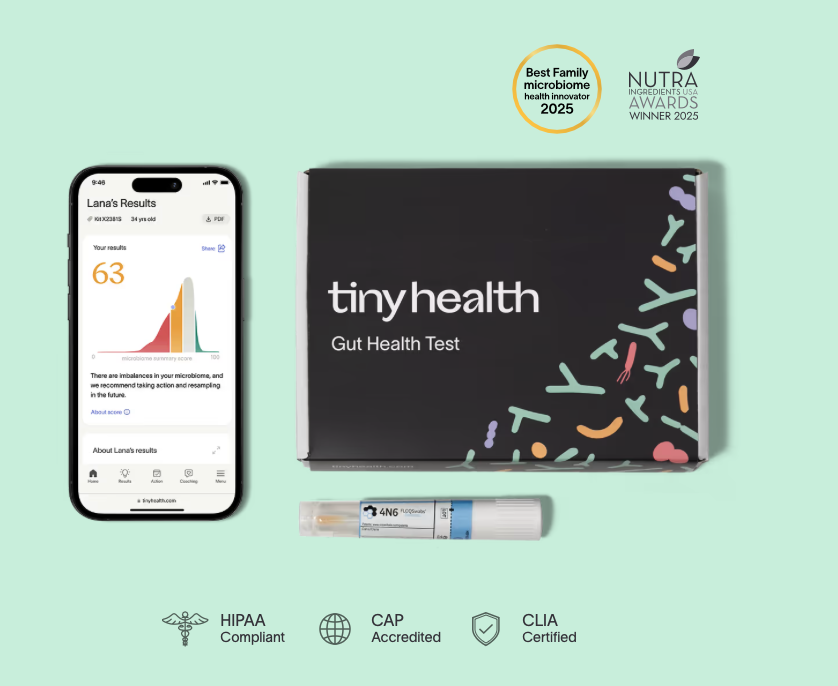
How old is your gut? You can find out with the Tiny Health Adult Gut Health Test, and the answer might surprise you — I know it surprised me!
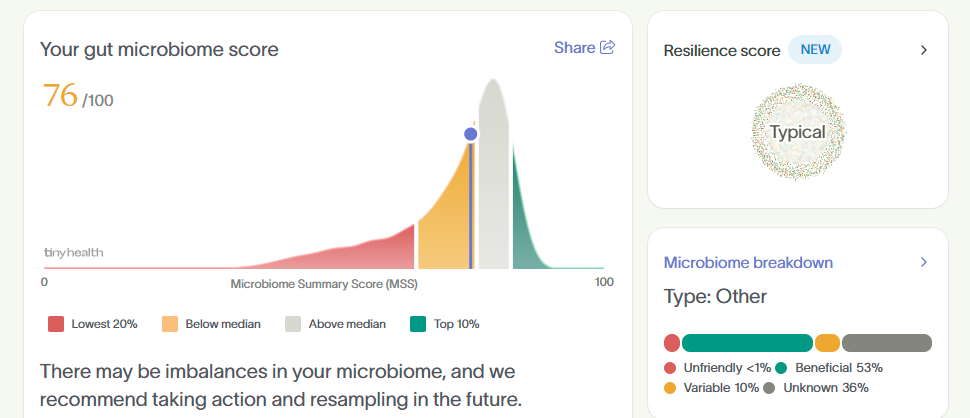
I’ve never done a gut health test, so when I received an offer to test the kit, I was intrigued. I’ll get into all of the details below, but what surprised me the most was that despite not having any gut health symptoms my microbiome score was 76/100, which is below the median. My microbiome age is 48.5 years old — 8.5 years older than 40, my real age at the time of the test.
Luckily, the Adult Gut Health Test comes with a consultation with a practitioner who recommended different foods and supplements that can help me improve my gut microbiome. While I haven’t taken a second test to see how the changes have impacted my gut health, I have been able to incorporate some foods that I probably wouldn’t have otherwise, like eating sauerkraut and yogurt more frequently.
Here’s how the gut health test went and what you can expect when you do your own.
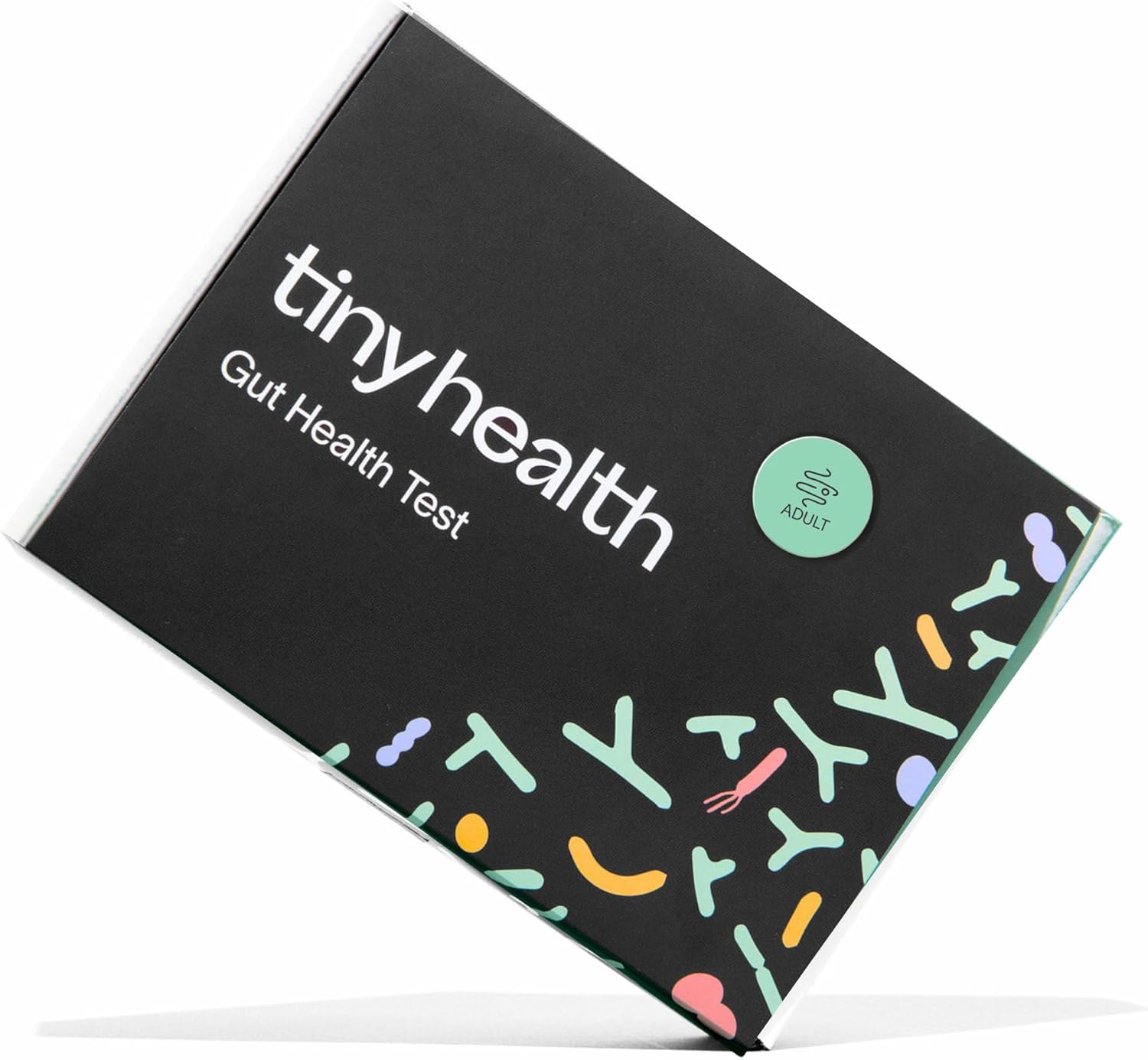
Tiny Health Adult Gut Health Test
Pros
- Robust results.
- Easy-to-navigate dashboard.
- No-mess test.
Cons
- Expensive.
- Need to retest to check for improvements.
Specifications
- Price: $249 per test; $399 per year.
- Testing difficulty: Easy.
- Wait time for results: 3-4 weeks.
What Is Tiny Health?
Tiny Health was born after founder Cheryl Sew Hoy had two very different birth experiences — the first via c-section and the second vaginal — and saw the resulting differences in her childrens’ gut health. The first struggled with eczema and a sesame allergy as a result of the unfriendly bacteria she was exposed to during the c-section.
Because there weren’t gut tests available for babies at the time, Cheryl went on a quest to assemble a team of scientists, physicians, and microbiologists to ultimately develop Tiny Health Baby Gut Test as a test for infants. From there, they expanded their tests to include Child Gut Test, Adult Gut Test, Pregnancy Gut Health Test, and Vaginal Health Test.
How the Test Works
We’re talking about testing gut health, and with that comes a stool sample — probably the thing that would keep most people away. But this test was super easy. The kit comes with clear directions and all you need to do is take a small sample from a piece of toilet paper after you have a bowel movement. No mess!
After getting the sample, you just put it into the prelabeled box and then send it off to the company. The lab tests it, and results show up on your Tiny Health dashboard a few weeks later.
Reading the Results
The Tiny Health dashboard is very easy to navigate. The test results are broken down by the different types of bacteria and the scale clearly shows where your results land as well as the normal range.
Getting Recommendations
My test came with a consultation with a nutritionist who looked over my results with me and got a sense of my lifestyle and routines, so she could make the most relevant recommendations.
As we went through the results and she recommended certain foods and supplements that I could incorporate into my day, she bookmarked them within the dashboard. Now, under the Bookmark tab, I can see all of her recommendations, making it easy to add them to my grocery list.
Tiny Health Features
Within the Tiny Health dashboard there are a lot of features that make it easier to understand what’s going on in my gut. I want to share a few, but there are more that you can explore.
Results
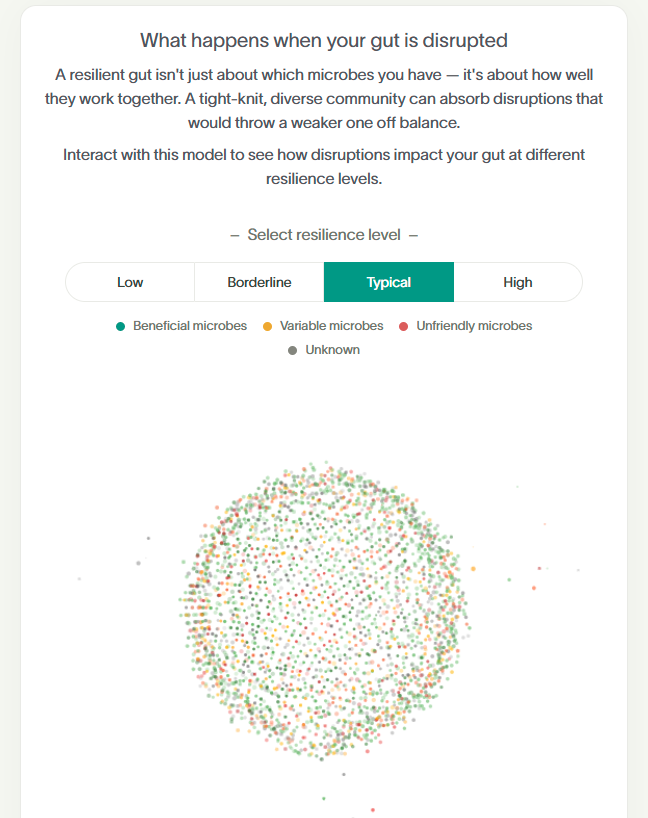
The results page shows an overview of all of the results, including the microbiome score, resilience score, microbiome breakdown, metrics and more. From this page, you can explore each result and get tips for how to make improvements and adjustments. For instance, when you click on the resilience score, you get a closer look at how disruptions, such as taking an antibiotic or getting sick, might affect your gut. This one comes with an interactive illustration that gives you a visual sense of what this actually means.
The results are highly interactive. For example, under the “Your metrics” section on the main results page, my disruptive microbes are labeled as needing support. When I click on this box, it takes me to a list of the disruptive microbes, and I can click on each one that’s been flagged as too high. Then, it takes me to a page for that specific microbe which shows its level, condition associations, and the change over time which will appear after resampling.
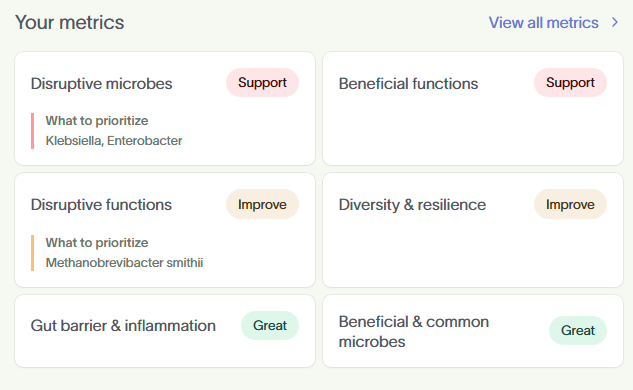
On the right side, you’ll see Action Items that will specifically address this issue. You can also access the action plan from here.
Towards the bottom of the page, you can click on “conditions,” and you’ll see how your personal metrics relate to certain conditions. Keep in mind that this test doesn’t diagnose any health conditions, but this information can act as data if you are suffering from conditions related to gut health.
Action Plan
The action plan is the next step in understanding how to improve your gut health. Tiny Health gives recommendations tailored to your gut’s needs. It gives food, lifestyle and supplement tips that focus on your specific results.
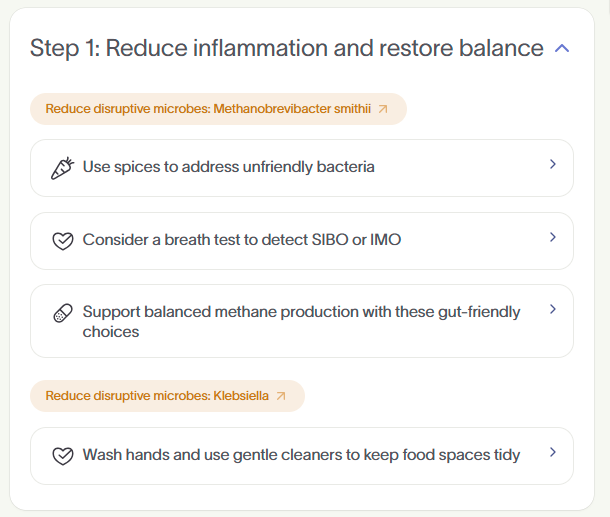
Action items are listed by steps, and when you click on an item, you’ll see a few general suggestions at the top. From there, you can scroll down to get more specifics about the foods and habits you can integrate into your diet and life. The best feature here is that you can bookmark the items that are the most doable and that you want to incorporate into your daily routines. When I did my consultation, the nutritionist bookmarked items as we talked based on my preferences and lifestyle — more on this in a minute.
Resources
If you want to go deeper into gut health, immunity, digestion and more, Tiny Health offers educational webinars right on their platform — and these aren’t two minute clips. Most webinars are over an hour and cover topics like the midlife brain-gut connection, how antibiotics affect gut health and tackling eczema.
There are also lots of blog articles and guides that cover even more topics, including peptides for gut health, why your gas smells bad and antibiotics for babies, among many others. Articles are written and reviewed by medical professionals, so if you want to dive deep, this is the place to go.
Bookmarks
The bookmarks tab is my favorite feature, and it works in conjunction with the consultation, but you can also use it on your own when you go through your results. Remember when I said you could bookmark items from your Action Plan? Well, this is where those bookmarks show up.
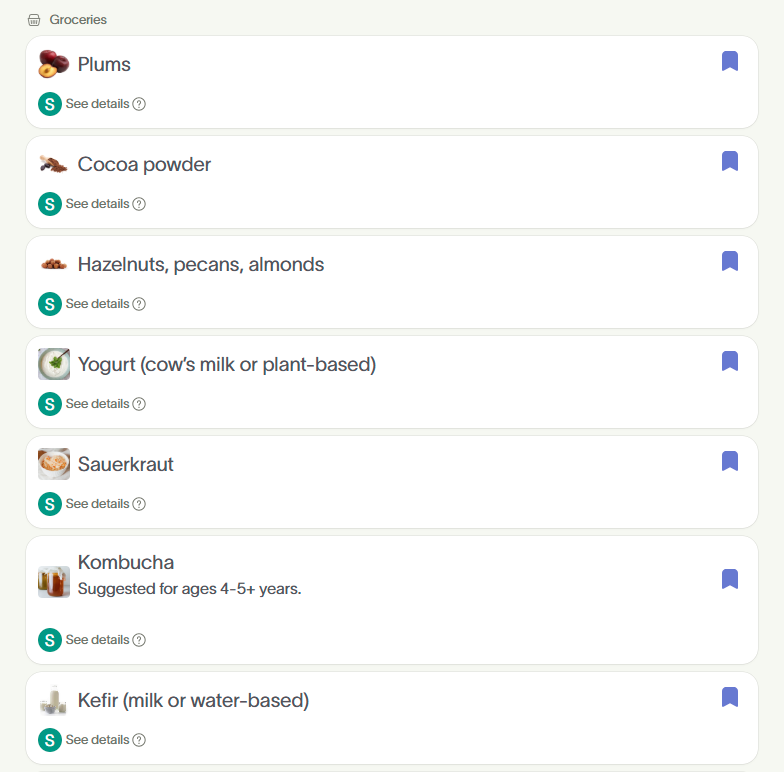
While you can definitely go through your results and bookmark the foods, habits and supplements that you want to integrate, my nutritionist did this in real time as we talked through my consultation. After our conversation, I was able to go back to this tab and see all of the recommendations. She suggested using it like a grocery list.
Paying for Tiny Health
An Adult Gut Health Test costs $249 and includes the test, the report, and a Personalized Results Review group session with a microbiome specialist. If you prefer a little more privacy or individualized attention or you want to resample regularly, you can upgrade to a Tiny+ Adult Membership. The membership is $399 per year and comes with a 1:1 functional health coaching call and unlimited text and email support, two Tiny Health Adult Gut Tests — one for a sample now and one to resample later — and reduced rates for additional function health coaching calls and additional tests for the family.
Tiny Health is also HSA/FSA eligible. To take advantage of this benefit, you need to get a Letter of Medical Necessity through TrueMed, and then use your pre-tax dollars to purchase your tests.
Tiny Health Adult Gut Health Test
In My Expert Opinion
I think this test is a really good way to get started on improving gut health. Because I didn’t have any gut health symptoms, I was surprised by my results and have worked to add in certain food that can help improve what’s going on in my gut.
For people with symptoms like constipation, eczema, hypertension, menopause symptoms and more, this test can offer a window into what’s actually going on. Personalized suggestions mean you can focus on the foods and supplements that will make the most difference rather than blindly adding or subtracting foods from your diet. Taking a second test will then show you your progress over time to see what’s working.
